Inspecting a Fitted SGT
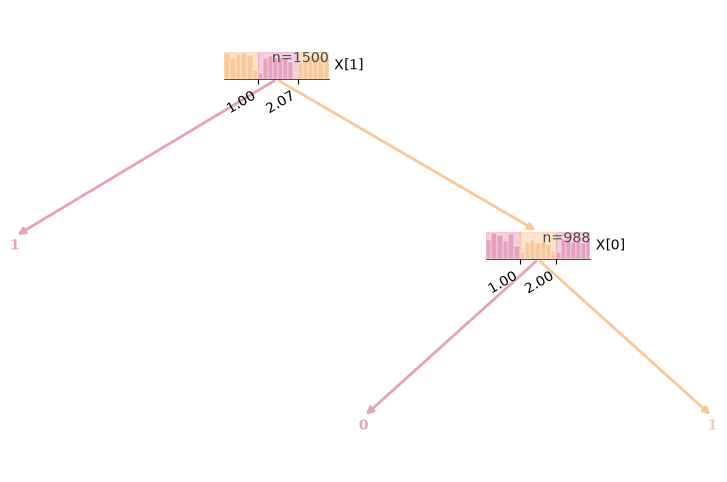
A fitted SGT is fully introspectable: tree_export() returns a plain dict describing every node — its routing feature, bin thresholds, which child each bin goes to, and the leaf statistics. This notebook walks that structure and pairs it with plot_tree.
[1]:
import json
from sgtlearn import SGTClassifier, plot_tree, make_plus

X, y = make_plus(n_samples=1500, grid=3, margin=0.07, random_state=42)
model = SGTClassifier(max_depth=2, inner_max_depth=2, tao_n_runs=0, random_state=42).fit(X, y)

export = model.tree_export()
print("top-level keys:", list(export))
print("num_partitions:", export["num_partitions"], " num_nodes:", export["num_nodes"], " root:", export["root_index"])
top-level keys: ['num_partitions', 'num_nodes', 'root_index', 'num_classes', 'criterion', 'nodes']
num_partitions: 2  num_nodes: 5  root: 0
[2]:
# Look at the root node's routing rule.
root = export["nodes"][export["root_index"]]
print(json.dumps({k: root[k] for k in root if k != "bin_counts"}, indent=2, default=str))
{
  "id": 0,
  "depth": 0,
  "is_leaf": false,
  "impurity": 0.49777777777777776,
  "class_counts": [
    700.0,
    800.0
  ],
  "n_samples": 1500,
  "feature": 1,
  "thresholds": [
    0.9987961053848267,
    2.0737411975860596,
    2.900710105895996
  ],
  "bin_to_partition": [
    1,
    0,
    1,
    1
  ],
  "bin_weights": [
    509.0,
    512.0,
    462.0,
    17.0
  ],
  "bin_sample_counts": [
    509,
    512,
    462,
    17
  ],
  "nan_prediction_partition": 1,
  "children": [
    1,
    2
  ]
}
Reading a node
feature— the column this node routes on (None at a leaf).thresholds— the inner-tree bin edges along that feature.bin_to_partition— for each bin, which child (partition) samples in that bin go to.children— child node ids, indexed by partition.nan_prediction_partition— where non-finite values route.Leaves carry
class_counts(classifier) orvalue(regressor) instead of a feature.
The routing rule is exactly: bin = searchsorted(thresholds, value, side="right"), then go to children[bin_to_partition[bin]].
[3]:
import matplotlib.pyplot as plt
fig, ax = plt.subplots(figsize=(9, 6))
plot_tree(model, X=X, ax=ax)   # same tree, visual form of the dict above
plt.show()
The export is read-only
tree_export() returns a copy. Mutating it does nothing to the model — there is no supported node-edit API. To change a fitted tree’s rules without retraining, use TAO; to change its structure, refit with different hyperparameters.
[4]:
# Demonstrate: editing the dict does not affect predictions.
before = model.predict(X[:10])
export["nodes"][export["root_index"]]["feature"] = 999   # mutate the copy
after = model.predict(X[:10])
print("predictions unchanged:", (before == after).all())
predictions unchanged: True