Categorical features with feature_dict
SGT splits are numeric: a node carves one feature with a shape function. To model a categorical variable, one-hot encode it and group the columns into a single logical feature with feature_dict. A multi-column group is routed through the one-hot inner discretizer, so a node branches on category buckets — and can merge categories into a bucket when the inner leaf budget is tight.
The shape of a feature_dict
The data below has six mutually-exclusive categories cat_A…cat_F, one-hot encoded into six columns. The target is the parity of the category index, so the tree does well only if it can branch on which category a row is.
feature_dict is how you tell the trainer those six columns are one variable. It maps a name you choose to the list of columns that encode it:
feature_dict = {"category": ["cat_A", "cat_B", "cat_C", "cat_D", "cat_E", "cat_F"]}
the key (
"category") is the logical feature’s name — it is what labels the split in the tree plot;the value is every column that belongs to that feature.
Because the list holds more than one column, SGT treats the feature as categorical and a node branches on category membership rather than a numeric threshold. A single-column entry — or any column you leave out of the dict — stays an ordinary continuous feature.
[1]:
import numpy as np
import pandas as pd
import matplotlib.pyplot as plt
from sgtlearn import SGTClassifier, plot_tree

rng = np.random.default_rng(7)
n, k = 500, 6
cats = rng.integers(0, k, size=n)
levels = [f"cat_{c}" for c in "ABCDEF"]  # synthetic, made-up category labels
X = pd.DataFrame(0.0, index=np.arange(n), columns=levels)
for row, c in enumerate(cats):
    X.iloc[row, c] = 1.0
y = (cats % 2).astype(np.int64)  # target = parity of the category index

feature_dict = {"category": list(levels)}
print(feature_dict)

clf = SGTClassifier(max_depth=3, random_state=0)
clf.fit(X, y, feature_dict=feature_dict)

plot_tree(clf, X=X.to_numpy(), class_names=["even", "odd"], label="all", fontsize=10)
plt.show()
{'category': ['cat_A', 'cat_B', 'cat_C', 'cat_D', 'cat_E', 'cat_F']}
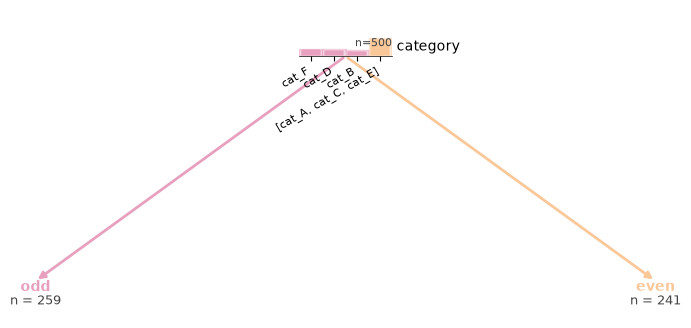
The split is on the category feature — the key we chose — and its branches are category buckets: a single category like cat_A, or a merged [cat_B, cat_C, …] bucket when the inner leaf budget forces categories to share a branch. No numeric cutoff appears. Keys and values may also be int column indices; the names above work because X is a DataFrame.
Building the dict for real data
Real categorical columns have too many levels to hand-list, so build the dict programmatically. One-hot each column with a prefix, then map the original column name to the dummy columns it produced:
dummies = pd.get_dummies(df[col], prefix=col)
feature_dict[col] = list(dummies.columns)
Repeat for every categorical column and you get one entry per variable. Numeric columns (age, fare) are never added, so they stay continuous. The printed dict below is the result — one key per titanic categorical, each mapped to its own one-hot columns.
[2]:
import seaborn as sns
from sklearn.model_selection import train_test_split

df = sns.load_dataset("titanic").dropna(
    subset=["sex", "class", "who", "embarked", "age", "fare", "survived"]
)
frames, feature_dict = [df[["age", "fare"]].astype(np.float32).reset_index(drop=True)], {}
for col in ["sex", "class", "who", "embarked"]:
    dummies = pd.get_dummies(df[col], prefix=col).astype(np.float32).reset_index(drop=True)
    feature_dict[col] = list(dummies.columns)
    frames.append(dummies)
print(feature_dict)

Xt = pd.concat(frames, axis=1)
yt = df["survived"].astype(np.int64).to_numpy()

Xtr, Xte, ytr, yte = train_test_split(Xt, yt, test_size=0.25, random_state=0)
clf_t = SGTClassifier(max_depth=3, random_state=0)
clf_t.fit(Xtr, ytr, feature_dict=feature_dict)
print(f"test accuracy: {clf_t.score(Xte, yte):.3f}")
{'sex': ['sex_female', 'sex_male'], 'class': ['class_First', 'class_Second', 'class_Third'], 'who': ['who_child', 'who_man', 'who_woman'], 'embarked': ['embarked_C', 'embarked_Q', 'embarked_S']}
test accuracy: 0.798
Forests take the same feature_dict; it is resolved once and shared across all trees.
[3]:
from sgtlearn import RandomSGForestClassifier

forest = RandomSGForestClassifier(
    n_estimators=50, max_depth=3, random_state=0, n_jobs=-1,
).fit(Xtr, ytr, feature_dict=feature_dict)
print(f"forest test accuracy: {forest.score(Xte, yte):.3f}")
forest test accuracy: 0.803
See Shape functions for what a node’s inner tree does, and SG forests for ensembling. The full resolution rules live in sgtlearn.configure_feature_dict.